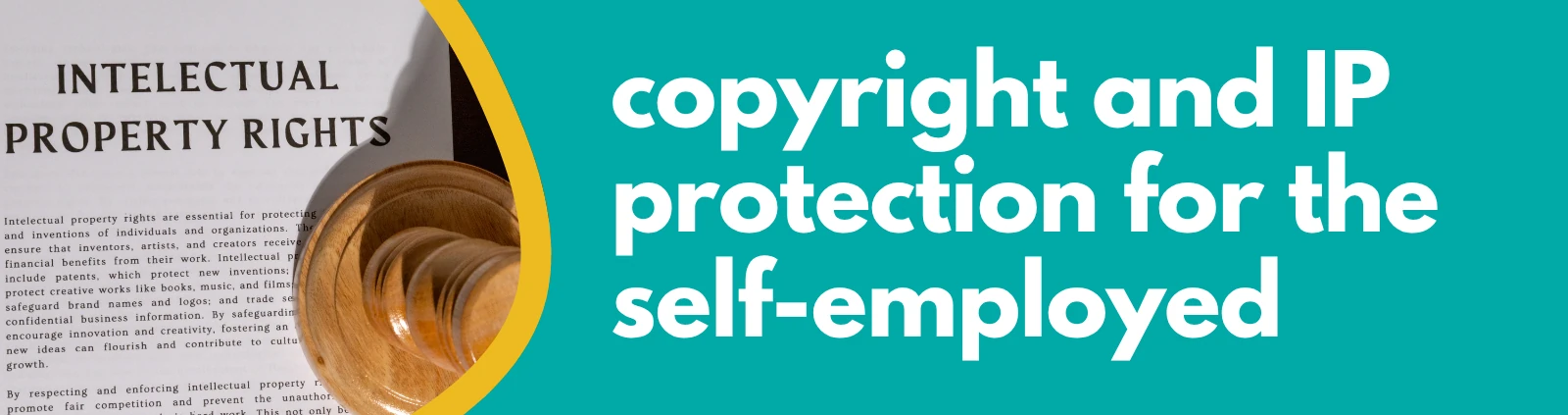
Copyright and IP Protection for the Self-Employed

Accounting Wise - Copyright and IP Protection for the Self-Employed
Get 50% off our services for the first 6 months when you sign up to one of our Pre-Built or Bespoke Packages!

When you work for yourself, your ideas are often your most valuable asset. The logo you designed, the name you trade under, the articles and photographs you produce, the code you write, the processes you have refined over years of practice. All of these can be classed as intellectual property, and all of them can be protected. Yet a surprising number of freelancers and sole traders leave their IP completely exposed, assuming that protection is something only large companies need to worry about.

This blog post looks at what intellectual property is, which types apply to self-employed workers, how to protect each one under UK law, and the practical steps you can take today. It is aimed at freelancers, sole traders, contractors and small business owners who want to safeguard what they have built without spending a fortune on legal fees.

What is intellectual property?

Intellectual property, usually shortened to IP, refers to creations of the mind that the law recognises as belonging to you. This includes brand names, logos, inventions, written and visual work, designs, and the confidential know-how that gives your business its edge.

In the UK, there are four main types of IP protection, and it is worth understanding them because they work in very different ways. Some protect your work automatically the moment you create it. Others only apply once you register them formally and pay a fee.

  • Copyright protects original creative and literary work such as writing, photography, illustration, music, film and software code. It arises automatically and does not need to be registered.
  • Trade marks protect the signs that identify your business, such as your name, logo or slogan. These must be registered to gain full protection.
  • Registered designs protect the appearance of a product, including its shape, colours, texture and decoration. These must be registered.
  • Patents protect inventions and how they work. These must be registered and are the most complex and expensive form of protection.

You can read the government’s overview of all four types on the GOV.UK intellectual property pages, which is the definitive starting point for any UK business owner.

Who does this apply to?

If you produce anything original in the course of your work, this applies to you. A freelance copywriter owns the copyright in the words they write. A graphic designer owns the copyright in their illustrations. A joiner who has developed a distinctive product might have a registrable design. A consultant trading under a memorable business name has something worth protecting as a trade mark.

Being a sole trader rather than a limited company makes no difference to whether you can own IP. As an individual, you can hold copyright, register trade marks, register designs and hold patents in your own name. The key difference is that your business and your personal legal identity are one and the same, so your IP is held by you directly rather than by a separate company.

A common and costly mistake is assuming that because you paid someone to create work for you, you automatically own it. In many cases the freelancer or agency who created the work retains the copyright unless a written assignment says otherwise. This cuts both ways, so it matters whether you are the one creating work or the one commissioning it.

Copyright: the protection you already have

Copyright is the most relevant form of IP for the majority of freelancers, and the good news is that you do not need to do anything to obtain it. Under UK law, copyright protects original work automatically from the moment it is created and fixed in a tangible form, whether that is a document, a design file, a recording or a line of code.

There is no copyright register in the UK and no official copyright application to submit. This is different from countries such as the United States, where registration is available and often advisable. In the UK, protection is automatic, which is convenient but also means you carry the burden of proving when and by whom the work was created if a dispute ever arises.

How to strengthen your copyright position

Because there is no register, sensible record keeping is your best defence. Practical steps include:

  • Marking your work with the copyright symbol, your name and the year, for example © A. Smith 2026. This is not legally required but signals ownership clearly.
  • Keeping dated drafts, original files and version histories that show the development of your work over time.
  • Emailing a copy of finished work to yourself or storing it in a timestamped cloud service, so you have independent evidence of the date of creation.
  • Using written contracts that state clearly who owns the copyright in commissioned work.

You can learn more about how copyright works and how long it lasts on the GOV.UK copyright guidance. In most cases, copyright in written and artistic work lasts for the creator’s lifetime plus 70 years.

Speak to an accounting expert

If you’re unsure what level of support you need, our friendly team are on hand to help you pick the right package for you.

Trade marks: protecting your name and brand

If you trade under a distinctive business name or use a recognisable logo, a registered trade mark gives you the exclusive right to use that mark for the goods or services you provide. Without registration, stopping someone else from using a similar name is far harder and relies on the more uncertain common law right known as passing off.

Trade marks are registered through the UK Intellectual Property Office, and you can apply yourself online without a solicitor or trade mark attorney. Before you apply, it is essential to search the existing register to check that no identical or confusingly similar mark already exists. Application fees are not refundable if your application is refused, so this check protects your money.

What it costs

The UK Intellectual Property Office increased its fees on 1 April 2026, the first trade mark fee rise since 1998. The current figures are:

  • A standard online application costs £205 for the first class of goods or services.
  • Each additional class costs £60.
  • The Right Start option lets you pay an initial fee and settle the balance only after you receive a favourable examination report, which reduces the risk if your mark is problematic.
  • Registration lasts for 10 years, after which you renew it. Renewal costs £245 for the first class, plus £60 for each additional class.

Classes matter because trade marks only protect you within the categories of goods and services you register for. A trade mark registered for accountancy services does not protect the same name if a completely unrelated business uses it for, say, garden furniture. You can search the register and apply through the GOV.UK trade mark service.

Registered designs: protecting how things look

If part of your business involves creating products with a distinctive appearance, a registered design protects the way that product looks, including its shape, pattern, contours and decoration. This is particularly relevant to makers, product designers, craftspeople and anyone selling physical goods with a unique visual identity.

Registration through the Intellectual Property Office gives you protection for up to 25 years, renewable every 5 years. As with trade marks, you can apply yourself, and the process is considerably cheaper and faster than a patent. Details are available on the GOV.UK register a design service.

Patents: protecting inventions

Patents protect the way an invention works and are the most demanding form of IP protection in terms of cost, time and complexity. If you have invented a genuinely new product or process, a patent can prevent others from making, using or selling it without your permission.

Patents are expensive and slow to obtain, often taking several years, and the process usually benefits from professional help from a patent attorney. For most freelancers and sole traders, patents will not be relevant, but if you believe you have a patentable invention, it is worth reading the GOV.UK guidance on patents before disclosing your idea to anyone. Publicly revealing an invention before applying can destroy your ability to patent it.

Contracts, confidentiality and getting ownership right

Formal registration is only part of the picture. For freelancers and sole traders, well-drafted contracts often do more day-to-day work than any IP registration.

When you create work for a client, your contract should state clearly whether you are assigning ownership of the IP to them or simply granting them a licence to use it. An assignment transfers ownership outright. A licence lets the client use the work while you retain the rights, which can be valuable if you want to reuse elements or license the same work again.

When you commission others to create work for your own business, such as a logo from a designer, make sure the contract assigns copyright to you in writing. Without that clause, the designer may retain ownership even though you paid for the work.

For confidential information, client lists, methods and know-how that give you a competitive advantage, a non-disclosure agreement can prevent others from sharing or exploiting what you tell them. This is often the simplest and cheapest protection available to a small business.

IP and your tax position

Intellectual property has an accounting and tax dimension that self-employed people should not overlook. The costs of registering trade marks, designs and patents, along with professional fees for advice, are generally allowable business expenses that reduce your taxable profit when you complete your Self Assessment tax return.

Where IP is a significant and enduring asset of the business, the treatment can be more nuanced, as some costs may be treated as capital rather than as an immediate deduction. If you later sell your business and its IP forms part of the sale, the proceeds may have Capital Gains Tax implications. Keeping clear records of what you paid to create and protect your IP is therefore sensible both for defending your rights and for reporting correctly to HMRC. If your IP portfolio is becoming valuable, it is worth speaking to an accountant about the most efficient treatment.

A practical action plan

You do not need to protect everything at once. A sensible order of priority for most freelancers and sole traders looks like this:

  • Start recording and dating your creative work so your automatic copyright is easy to evidence.
  • Put clear IP ownership clauses into every client contract you use.
  • Register your trading name or logo as a trade mark if your brand is central to your business and worth protecting.
  • Use non-disclosure agreements before sharing confidential ideas or information.
  • Consider a registered design if you sell products with a distinctive appearance.
  • Explore a patent only if you have a genuine invention, and take professional advice first.

Final thoughts on IP protection for self-employed individuals

Protecting your intellectual property as a freelancer or sole trader does not have to be complicated or expensive. Much of it costs nothing at all and simply requires good habits: dating your work, using clear contracts, and understanding what you own. Where formal protection is worthwhile, registering a trade mark or design through the Intellectual Property Office is straightforward and affordable, and the cost is usually deductible against your profits.

Your ideas, your brand and your creative output are the foundation of your business. Taking a little time to protect them now can save you a great deal of expense and stress later. If you are unsure how your IP should be treated for tax purposes, or you want help keeping your records in order, speaking to a qualified accountant is a sensible next step.

Useful Resources and Further Reading

Need help with your accounts as Freelancer? Contact Accounting Wise Today!

Copyright and IP Protection for the Self-Employed FAQ

No. Copyright is automatic in the UK from the moment you create original work. There is no register and no application. Keeping dated evidence of your work is the best way to protect your position.

Yes. As an individual you can apply for and hold a trade mark in your own name. You do not need to be a limited company to register one.

A registered trade mark lasts 10 years and can be renewed indefinitely for further 10-year periods, provided you pay the renewal fee on time.

Unless your contract says otherwise, you as the creator usually retain the copyright even though the client has paid you. If ownership is meant to transfer, the contract must include a written assignment.

Registration and professional fees are generally allowable business expenses that reduce your taxable profit, although the treatment of significant long-term IP assets can differ. Keep records and check with an accountant if the amounts are substantial.

Glossary of Key Intellectual Property Terms

Intellectual Property (IP) – Creations of the mind, such as brand names, logos, inventions, written or visual work and confidential know-how, that the law recognises as belonging to you.
Copyright – Automatic protection for original creative and literary work such as writing, photography, illustration, music, film and software code. No registration is required in the UK.
Trade Mark – A registered sign that identifies your business, such as a name, logo or slogan, giving you exclusive rights to use it for the goods or services you register.
Registered Design – Protection for the appearance of a product, including its shape, pattern, colours, texture and decoration.
Patent – Protection for an invention and the way it works, preventing others from making, using or selling it without permission. The most complex and costly form of IP.
Intellectual Property Office (IPO) – The UK government body responsible for granting patents and registering trade marks and designs.
Class – A category of goods or services under which a trade mark is registered. Protection only applies within the classes you register for.
Right Start – A trade mark application option where you pay an initial fee and settle the balance only after receiving a favourable examination report.
Passing Off – A common law right used to stop another business misrepresenting its goods or services as yours, relied on where no registered trade mark exists.
Assignment – The outright transfer of ownership of IP from one party to another, usually recorded in writing within a contract.
Licence – Permission to use IP while the original owner retains the rights, as opposed to transferring ownership.
Non-Disclosure Agreement (NDA) – A contract that prevents someone from sharing or exploiting confidential information you disclose to them.
Copyright Assignment – A written clause transferring copyright ownership, essential when commissioning work such as a logo so that you, not the creator, own it.
Capital Gains Tax (CGT) – A tax that may apply to the profit made when you sell an asset, including intellectual property, that has increased in value.
Allowable Business Expense – A cost, such as IP registration or professional fees, that can be deducted from your profits to reduce your taxable income.
Self Assessment – The HMRC system through which self-employed people report income and expenses, including deductible IP costs, and pay any tax due.
HMRC – His Majesty's Revenue and Customs, the UK government body responsible for collecting taxes.

Newsletter Subscription - Accounting Wise

Join Our Newsletter!

Get expert accounting tips, tax updates, and business insights straight to your inbox. Sign up today and stay one step ahead!

Newsletter Signup

Hot Topics

More related Accounting Community, News & Resources

Accounting Wise - how to budget effectively as a sole trader-final

How to Budget Effectively as a Sole Trader

Budgeting as a sole trader means knowing what you earn, what you owe, and what is genuinely yours to spend. This post looks at how to separate your money, set aside the right amount for Income Tax and Class 4 National Insurance, plan for payments on account, and stay ready for Making Tax Digital, along with the tools and accounts that make it all easier to manage.
Accounting Wise - sick pay for the self-employed

Sick Pay for the Self-Employed: What You Need to Know

Self-employed and wondering what happens if you get ill? You can't claim Statutory Sick Pay, but you're not left with nothing. This guide walks through New Style ESA, Universal Credit, PIP and income protection insurance, plus the practical steps worth taking now so a spell of illness never turns into a financial emergency.
Accounting Wise - the importance of customer reviews in e-commerce

The Importance of Customer Reviews in E-commerce

Customer reviews drive sales, trust, and search visibility for any online business. But since the fake reviews ban came into force in April 2025, UK e-commerce sellers also carry legal duties under the DMCC Act, with fines of up to 10% of global turnover. Here is how to use reviews effectively, stay compliant, and handle the accounting and VAT side correctly.